Circuits group worlds by the stories told in them; each circuit's physics is its law. A human in a Toon world is in a Toon story; an animated office worker in a grounded sitcom is in a Newtonian one. Every judge has a home circuit and sits in it; a judge of another circuit sits by designation only when a bench cannot otherwise be filled. The Supreme Court is the exception: nine Justices, fixed, who sit nowhere else.
SCFC
Nine Justices. Discretionary review, Rule of Four Fingers. Final authority on questions of the Charter and on the recognition of foreign judgments.
Reporter: F.C.
CODE
CIRCUIT
PHYSICS
DISTRICTS, DIVISIONS, BENCH
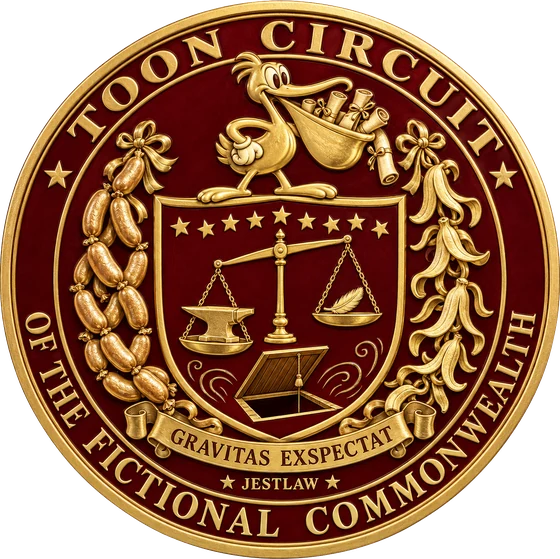
TOON
Gravity waits for the look-down; injury is temporary; the chase is the job.
Painted Desert District (Tax Division, Desert Revenue Code); bankruptcy division. Anvilworth, C.J.; Gage, J.; legacy Judges Jones, Bunning and Carrot. Successor to the Ninth Cartoon Circuit.
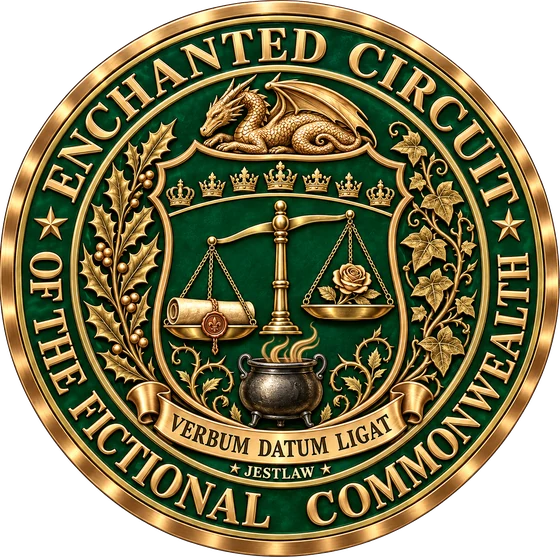
ENCH
Magic is enforceable; bargains bind; curses run with the land.
Deepwood District (equity); Castle and Kingdom districts. Plume, J.
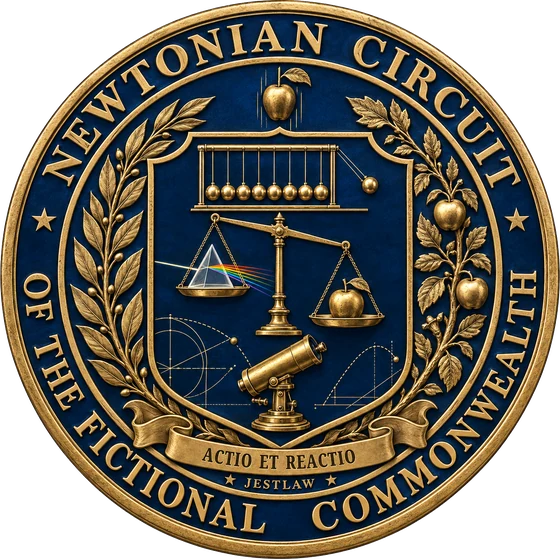
NEWT
The control group: real-world physics is binding authority. What would happen in our world happens here. Ordinary tort, contract and family law.
North Suburban District (family); Workplace District. Hollis, J.
METR
Powers exist, masks are lawful, rescue is a duty of care.
Metroville District; Court of Secret Identities. Steelgrave, J.
FRNT
Where the law stops. The high seas were the first place with none, and whoever takes a ship on them answers here; after that the open range past the last posted ordinance, the deep, the ice, the edge of the map. The physics is ordinary. What is missing is anyone to enforce it. The Frontier sits in admiralty.
Territorial districts; the Admiralty and Prize Docket (the high seas are the Frontier's); Submersible and Expedition dockets. Lasso, J. (shared with Stellar).
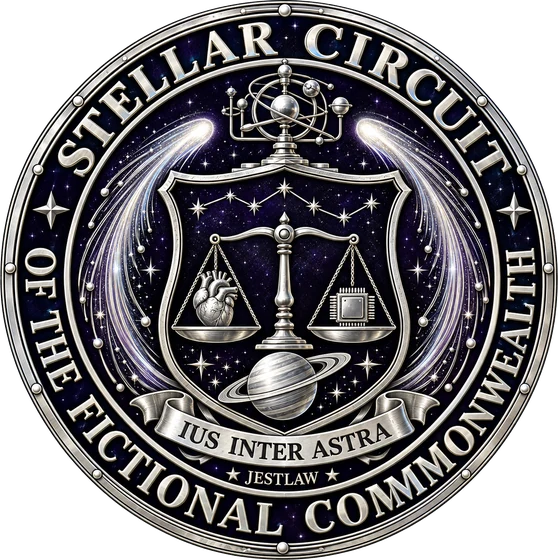
STLR
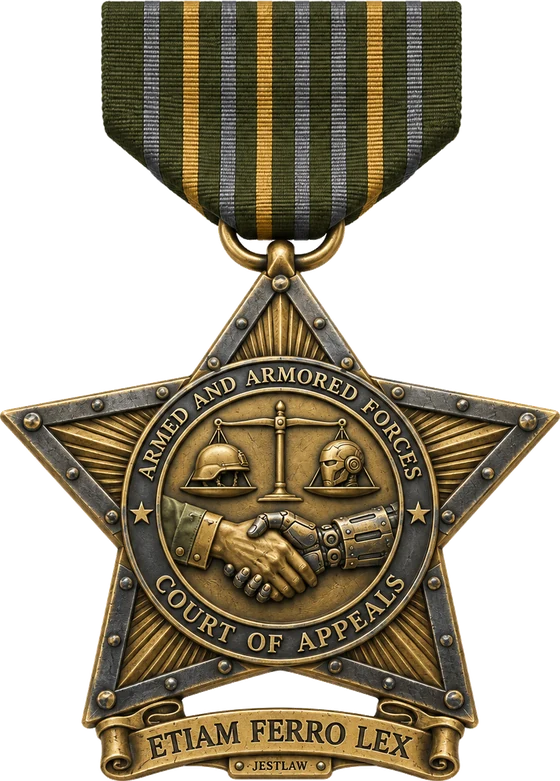
Space, androids, arcades; personhood follows the mind, not the material.
Orbital District; Arcade Division; Court of Appeals for the Armed and Armored Forces. Orrery, J., Chief Judge.
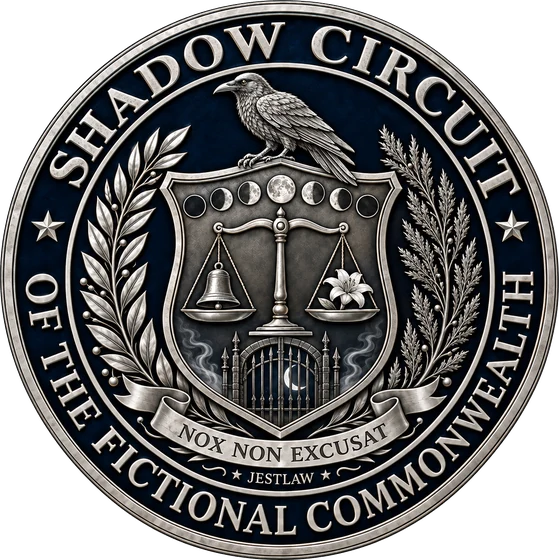
SHDW
Horror and gothic; the dead have standing; night is the default.
Nocturnal District. Vesper, J., Chief Judge.
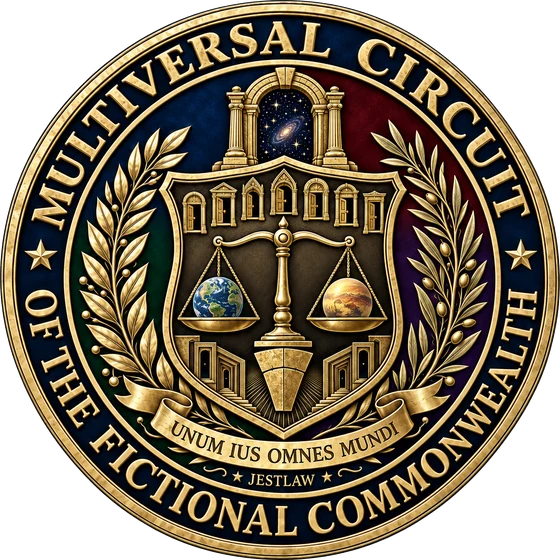
MULT
Subject-matter circuit, the Federal Circuit analog, for crossings, portals and foreign judgments with no physics match. Any world when a case crosses frames.
Judicial Panel on Multi-Dimensional Litigation; Court of Inter-Universal Trade; Foreign Judgments Docket. Interframe, J., Chief Judge.
STANDING TRIBUNAL · NOT AN ARTICLE II COURT
Sovereign against sovereign, on the consent of both. Panels of three, drawn from a standing Panel of Arbitrators from across the worlds. It issues awards, not opinions; enforcement runs through the courts on comity. Charter Rule 6.
Reporter: F.C. Arb. · PAX PER ARBITRIUM
Mixed worlds are the rule, not the exception. The petitioner chooses a connected circuit. On objection the court weighs the story, the physics of the act and the nature of the harm, and keeps the case or transfers it to the more convenient court (Charter Rules 1.5 and 1.6). The Commonwealth's first word on mixed worlds is In re Assignment of the Toon Docket, 2 F.C. 30 (1948). Eight principles of the series follow.
Medium connects nothing. Animation is how a world is drawn. Toon requires Toon physics. Fry v. Planet Express, the Hard-Landing Test.
The frame governs the event; the body governs the body. A character carries its own physics wherever it goes. Maroon Cartoon Studios v. Valiant.
The rule that decided the outcome weighs most on a motion for a more convenient court. A superhero fight drawn as a cartoon is a superhero fight. Morales v. Fisk, the Glitch Test.
Multiversal is a subject-matter circuit, not a home. A harm done in the crossing itself is its, whether or not anyone objects; a claim after arrival is filed in a connected circuit of the world arrived in, as the petitioner chooses. Jetson v. Flintstone, the Frame of Arrival Rule.
What actually caused the harm weighs, not what it looked like. Where that is still unknown (the ghost who may be a man in a mask), the motion is stayed until it is known (Rule 1.6(a)). Rogers v. Mystery Inc.
Magic with a ruleset is Arcade; magic with a moral is Enchanted. Mushroom Kingdom v. Mario Bros., the Rules Test.
The Frontier begins where the law stops. Between Newtonian and Frontier the question is whether the place had law when the harm happened. Ordinary physics within reach of a sheriff, a court or a posted ordinance is Newtonian; the same physics past the last law, or on the high seas, is the Frontier's, and the Frontier sits in admiralty. A forest with a sheriff is Newtonian; the same forest past the last posted law is the Frontier's. Charter Rule 1.4(a), the Last Law Rule.
Water divides at the last light. A river, a harbor or a coast within reach of a world's law is that world's circuit's, whatever floats on it; the high seas, beyond every sovereign, are the Frontier's, sitting in admiralty, and the Admiralty and Prize Docket follows the ship into port. The flag's law sails with the company for what is done aboard and among themselves; the law of the place governs what is done to the place. A traveler in time carries nothing a flag does not carry for him. Charter Rule 1.4(b)–(d).
Many worlds keep courts of their own: kingdoms, empires, planets, the past. The Commonwealth does not sit in appeal over them. It decides whether to recognize what they have done, on the same terms a real court would.
RULES
Recognition. A foreign judgment is honored if the tribunal was impartial, the defendant had notice and a hearing, there was no fraud, and the result is not repugnant to the Charter. Comity; the Hilton v. Guyot analog.
Venue by physics. A recognition proceeding is filed in the circuit whose physics most resembles the rendering court's world. Where none does, the Foreign Judgments Docket of the Multiversal Circuit. Appeal runs up that circuit as usual.
Extradition. Requires dual criminality and a treaty or reciprocity. Refused for political offenses and where the sentence would be cruel under Amendment II. The Soering principle.
Sovereign acts. Commonwealth courts will not judge the validity of a foreign sovereign's acts within its own territory, and foreign sovereigns are immune except for commercial activity. Act of state; the FSIA analog.
Foreign physics is law, not fact. A court may determine another world's physics from the source material and need not hear witnesses on whether gravity waits. The Rule 44.1 analog.
Judgments across time. The law of a world at the time of judgment governs its validity; a later era's physics does not reopen it. A judgment of a sovereign that no longer exists is honored to the extent its acts were necessary to ordinary life. The de facto government doctrine.
QUESTIONS THE COURT HAS BEEN ASKED
In re Judgment of the Queen of Hearts ENCHWhether a tribunal that announces the sentence before the verdict has afforded a hearing, and what a court must find before it recognizes a foreign judgment at all.
In re Extradition of Hood FRNTWhether redistributing the Sheriff of Nottingham's revenue is a political offense, and whether a proposed sentence that offends Amendment II bars extradition.
Gale v. The Wizard ENCHWhether the Commonwealth may review a decree of the Emerald City issued within Oz, even one issued from behind a curtain, and whether sovereign immunity reaches the Wizard's balloon business.
Organa v. Galactic Empire STLRWhat a conviction by the occupying power of a destroyed planet is worth here: whether its routine acts may be recognized while a sentence repugnant to Amendment II is not.
Lilliput v. Gulliver MULTWhether a foreign sovereign that sues in the Commonwealth waives immunity against a counterclaim, and whether the Court may take judicial notice of Lilliputian scale rather than hear experts.
Scrooge v. Marley's Estate SHDWWhether a judgment entered by spirits in a single night, in a time not yet arrived, binds a living defendant before that time arrives.