The Bar of the Supreme Court
← ADMISSION TO THE BARThe Supreme Court asks more of its bar than any court below it. To practice before it — to petition for review, to file a brief, or to write as a friend of the Court in a Supreme Court matter — a member must hold the bar of all eight circuits and then pass its own examination.
ITS FILM AND TRANSCRIPT, NARRATED BY INKWELL, C.J., ARE FORTHCOMING. THE RULE BELOW GOVERNS.
THE RULE · THE BAR OF THE SUPREME COURT
- 01
Eligibility. A member of the bar of the Commonwealth who holds the bar of every one of the eight circuits: Toon, Enchanted, Newtonian, Metropolitan, Frontier, Stellar, Shadow and Multiversal. The home circuit counts, and so does a bar held under the founding waiver; an appearance pro hac vice does not.
- 02
The examination. Twenty questions drawn from the eight circuits, the Charter and the Supreme Court’s own practice and decisions; seventeen correct, 85 percent, to pass. One sitting a week: the next opens seven days after the last is marked, and every sitting draws a fresh paper.
- 03
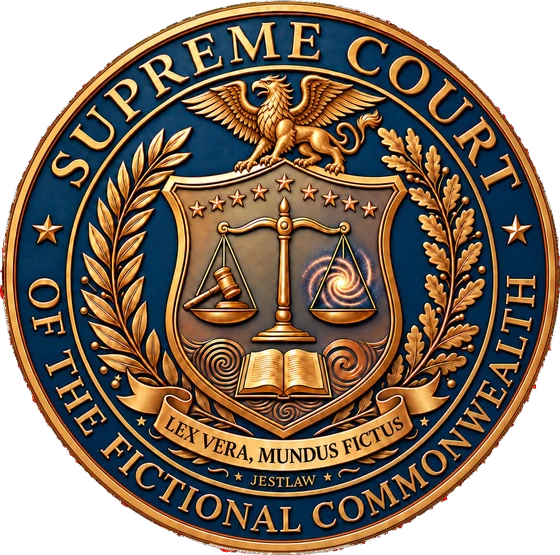
The oath. The Supreme Court’s clause, sworn after the Commonwealth’s and the circuits’ and signed under the pen name. The Court’s seal is then pressed onto the certificate, in gold, beside the endorsement row.
- 04
What it licenses. Papers in the Supreme Court are filed only by members of its bar: a petition for review, a brief, an amicus brief, an appearance. There is no appearance pro hac vice in the Supreme Court.
- 05
The bench. The founder and the Justices, sitting as the bench, are not appearing before the Court, and the votes on review are theirs as before. A judge who files as counsel files under the pen like any member, and needs the bar like any member.
The bar of the Supreme Court is the last of the bars. Admission to the bar of the Commonwealth comes first, then the eight circuits, then this examination.